
Part 1: Why a Drop Zone Helps and How to Plan One for Real Life
There’s a very specific moment that happens in so many homes at the end of the day.
You walk in, holding your bag, perhaps the kids are behind you, everyone is a little tired, and home is supposed to feel peaceful. But before you even get to exhale, you notice shoes strewn over the floor, a jacket dumped over a chair, paper piles on the kitchen counter, and no clear place to put your keys. And suddenly, it feels like the day is still chasing you.
If that sounds familiar, you are not doing anything wrong. It usually just means your home is missing a simple landing space for everyday life. That is exactly what a drop zone is.
A drop zone is a small, intentional space near your main entry point where the things you carry in and out every day can land properly. It helps stop the clutter at the door before it spreads through the rest of your home. And while it absolutely helps with tidiness, what I love most about it is the way it changes the feeling of coming home.
When your entrance is cluttered, it creates instant mental noise. Your brain sees every item as one more thing to deal with. A drop zone softens that. It gives your home a calmer start and a gentler ending to the day.
Start with the door your family actually uses
One of the easiest mistakes to make is setting up a beautiful system in the wrong place. Your drop zone does not have to be at the front door if that is not where life happens. For many families, the real entry point is the garage or even the kitchen door. That is where your drop zone belongs.
The goal is not to create a picture-perfect corner, but rather a space that catches the everyday mess where it naturally lands. Even a small wall, a corner near the door, or some room beside a cupboard can work beautifully.
Notice what comes through the door with you
Before you buy anything, take a quiet moment to notice what arrives home with your family every day. Usually it is the same things again and again. Bags, shoes, jackets, keys, sunglasses, dog leads, school bags, sports gear, lunch bags, and a surprising amount of paper.
None of these things are the problem. They are just waiting for a home. The moment you start planning around what your family actually carries, your drop zone becomes much easier to set up and much easier to keep tidy.
Think about flow before you think about storage
A good drop zone is less about how it looks and more about how it works. It should feel easy. Intuitive. Almost automatic.
You walk in, shoes come off, bags get hung up, keys go in one place, paper finds it spot. No second-guessing. No moving things around later. No mental effort.
That gentle flow is what makes such a big difference, especially at the end of a long day when everyone is tired and decision fatigue is a real challenge.
When a system is simple enough to use without thinking, it is much more likely to stick.
Plan five “homes” your drop zone needs
Before you set it up, it helps to think in simple categories.
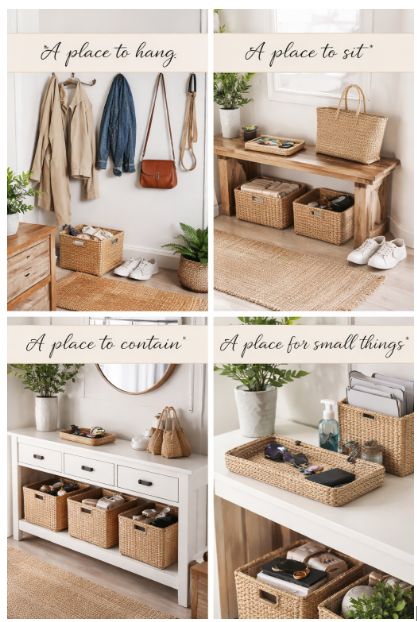
Most family drop zones need five basic homes:
- a place to hang things
- a place to sit or pause
- a place to contain shoes and bags
- a place for small everyday essentials
- a place for paper
And if your mornings tend to feel rushed, one extra basket for “things that need to leave tomorrow” can make a huge difference.
In Part 2, I’ll show you how to set up each of these in a practical, low-stress way so your drop zone feels calm, useful, and easy to maintain.
If you’d like help creating a drop zone that fits your space and your family rhythm, I’d love to help. At Simply Sorted, I create real-life systems that are easy to maintain, so your home can feel calmer from the moment you walk through the door.
Because clutter doesn’t have to follow you in. You can stop it at the door.